
AI-Driven Strategy: Understand Markets, Competitors and Portfolios Through Data

For a long time, strategic decisions were shaped by qualitative assessments, expert judgment, and selective market studies. Today, artificial intelligence opens up a new data foundation: competitor movements can be monitored on a daily basis, customer segments can be identified more precisely, portfolios can be structured based on real value drivers, and strategic scenarios can be quantified. This does not turn strategy into mathematics – but it gives it an empirical depth that grounds hypotheses in measurable evidence.

Why AI in Strategy – and Why Now?

Three developments are changing the requirements for strategic decision-making:

  • Greater market dynamics: Competitive moves, consolidation, and new business models are emerging faster than ever. Strategies that are revised once a year are often already outdated by the time they are approved.
  • Availability of external data: Web content, patent databases, job postings, financial data, social media – never have so many external data sources been so easily accessible. The challenge is shifting from data collection to data interpretation.
  • More mature AI methods: Embeddings, large language models, and automated pipelines enable analyses that, only a few years ago, would have tied up an entire research team.

The result: strategy processes become faster, more granular, and more firmly grounded in measurable evidence – without diminishing the importance of experience and judgment.

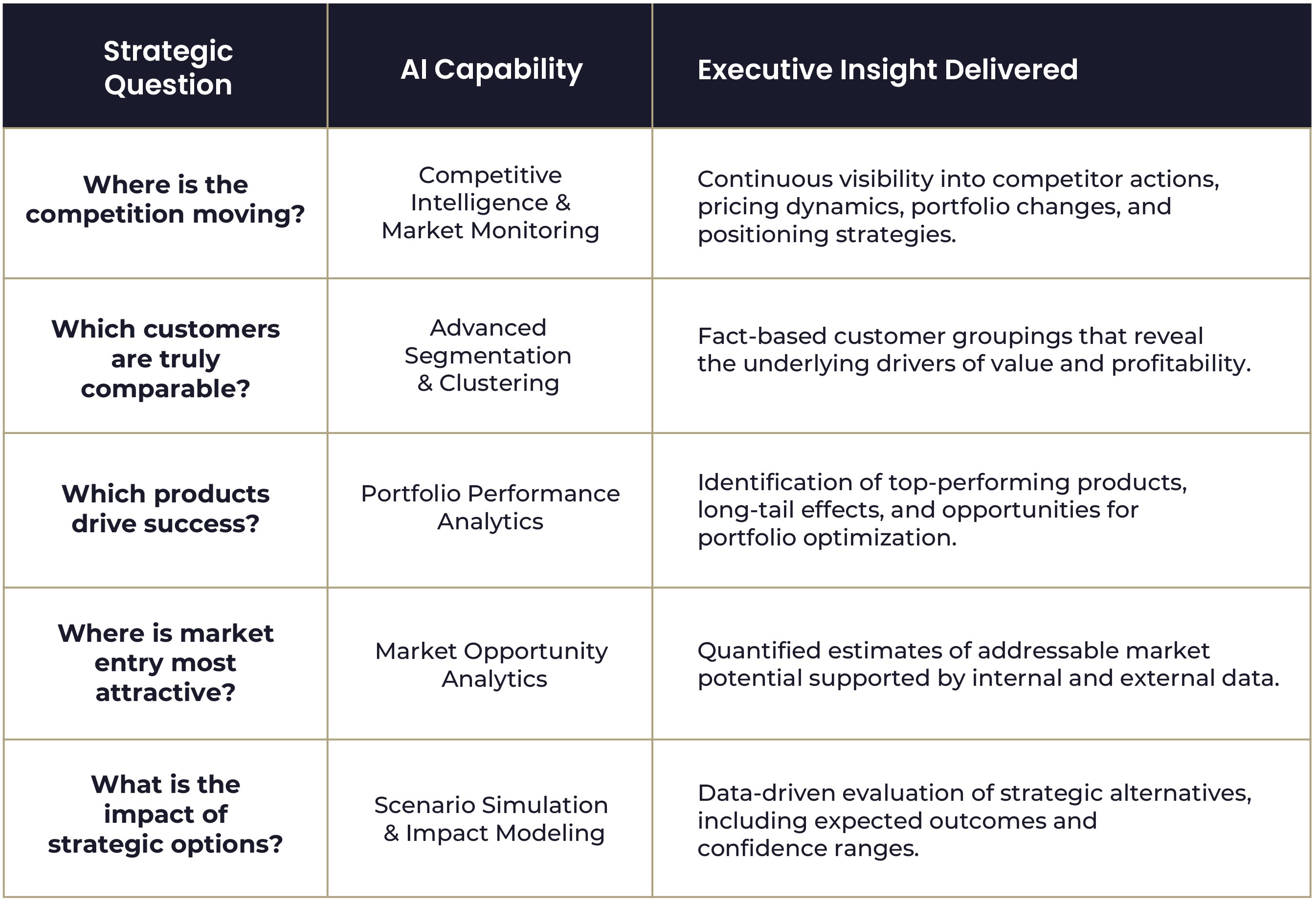
AI Levers in Strategic Questions

Our Strategy Use Cases

The following three use cases are based on real R&P projects and show how AI can provide a stronger foundation for strategic decisions.


Starting point Traditional segmentations are often based on demographic or geographic criteria – but they rarely reflect actual needs and behavioral patterns. Strategic decisions about growth segments, sales models, and service levels are then based on a segmentation that does not hold up in the market. Approach We combine historical transaction, usage, and interaction data with external enrichment and apply unsupervised learning methods (k-means, hierarchical clustering, and DBSCAN) to identify data-driven segments. Embedding-based similarity measures also capture complex demand patterns. Each segment is characterized by value drivers, profitability, and strategic attractiveness. Result • 5–8 data-driven segments with clear value drivers instead of 20+ vague criterion-based segments • Profitability differences between segments become visible • Consistent derivation of differentiated sales, service, and pricing models • Strategic growth decisions based on empirically validated segment logic
Starting point Product portfolios often grow organically over many years – leading to increasing complexity, unclear performance across different areas, and a lack of transparency around cross-subsidization. Strategic assortment decisions are made on the basis of data that cannot adequately differentiate the long tail. Approach We analyze the entire portfolio along dimensions such as revenue, margin, growth, strategic relevance and substitutability. AI models automatically identify value drivers within product families, uncover mispricing candidates, and cluster the long tail into manageable categories. The result is a data-based portfolio roadmap with clear recommendations. Result • Transparency on the performance of each product group instead of an aggregated view • 10–20% of products identified as candidates for streamlining or repricing • Consistent price relationships across variants and configurations • Strategic assortment decisions based on empirical evidence
Starting point Strategic decisions about new markets, regions, or customer segments are often based on extrapolations from a small number of market studies and qualitative assessments. Market potential is systematically over- or underestimated, and concrete target customer profiles are missing. Approach We combine internal sales and performance data with external sources such as company databases, web data, and industry indicators. Based on this, we develop a market potential model that quantifies entry attractiveness by region, industry, or segment. We also identify target customers with a high probability of conversion. The result is a prioritized market entry roadmap with concrete target customer lists. Result • Quantified market potential at industry, regional, or segment level • Concrete target customer list with high conversion probability • Market entry decisions based on a fact base rather than gut feeling • Pipeline development from day one after market entry

The percentages and timeframes stated above represent typical potential that can be realized in projects of this kind. The actual impact depends on the starting situation, data maturity, and speed of implementation and is quantified individually as part of the project.

How We Work: The R&P Approach to AI-Driven Strategy

Phase 1 – Sharpen the Strategic Question

AI-supported strategy work does not begin with a model, but with a precise question. Together with you, we identify the strategic decisions that will be relevant over the next 12–24 months and derive the specific data questions from them.

Phase 2 – Build the Data Foundation and Develop the Model

We create the data foundation from internal and external sources – iteratively and aligned with the specific decision situation. Within 8–12 weeks, we develop the model and bring the first robust results into the strategy discussion.

Phase 3 – Derive Strategic Conclusions

Model results are not the end of strategy work, but the starting point. Our consultants translate the data into actionable recommendations, test them for strategic robustness, and prepare them for top management and supervisory bodies.

Phase 4 – Embed and Make Repeatable

Strategic AI models realize their full value when they become repeatable – as ongoing market intelligence, as an annually updated portfolio assessment, or as a continuous win/loss radar. We embed the models into your processes and enable your strategy and marketing teams to use them independently.

Success Factors: When AI in Strategy Truly Creates Value

  1. Clear strategic question: Without a precise question, AI produces elegant models without impact. The question comes first, the model second.
  2. Willingness to work from facts: Data sometimes contradicts intuition. Successful strategy work embraces this tension instead of explaining it away.
  3. Connection between model and judgment: AI results do not replace strategic assessment – they inform it. Consulting experience remains indispensable.
  4. Top-management sponsorship: Strategic AI projects need board-level backing – otherwise, their results will not guide action.
  5. Repeatability: One-off analyses quickly lose value. Real impact comes from ongoing models that evolve with the market and customers.

The R&P USP: Strategy and AI – Under One Roof

While other providers offer either traditional strategy consulting or pure data analytics projects, Roll & Pastuch combines both worlds:

  • Many years of consulting experience in strategy and business model development – with reference projects in growth strategy, market entry, and portfolio management.
  • In-house Data Science Unit with a focus on strategy-relevant methods – from web scraping to NLP.
  • Pragmatic consulting approach – fast, hypothesis-driven iteration instead of a research marathon.
  • Focus on implementation – every analysis leads to concrete strategic recommendations.
  • Industry expertise in mechanical engineering, chemicals, electronics, consumer goods, software, and more.

Let’s Talk About Your Strategic AI Initiative

Which of your strategic questions can be answered more robustly with AI can usually be clarified in a 60-minute initial consultation. We bring our methodological and industry experience, you bring your strategic agenda – by the end of the conversation, you will have a clear view of a possible first step.

Schedule an initial consultation

Your contacts

Managing Partner

Kai Pastuch is Managing Partner of Prof. Roll & Pastuch. Before joining as Managing Partner, he was Director at a leading international strategy and marketing consultancy. As a graduate in business informatics, he also manages our software company nueprice, which specializes in the pricing of spare parts with the product of the same name. Mr. Pastuch has extensive project management experience from numerous projects for large international companies and German medium-sized businesses in the areas of price management, marketing, sales and strategy. In addition to numerous publications in renowned journals and the publication of the reference books Praxishandbuch Preismanagement and Big Deal Management, he is a sought-after moderator and speaker on all aspects of sales and pricing. As a practice-oriented manager, he likes to get personally involved in our projects and contributes his broad experience in workshops and steerings.

Managing Partner

Prof. Dr. Oliver Roll is Managing Partner at Prof. Roll & Pastuch. He is one of the leading pricing experts in the DACH region and has led pricing, sales and strategy projects for numerous international companies. Furthermore Prof. Roll is a key note speaker on the topic of price management and has published numerous articles on various aspects of the pricing process. Prof. Roll holds the chair of „Price Management“ at the Osnabrück University of Applied Sciences.

Karsten Konrad ist Senior Project Manager von Roll & Pastuch
Dr. Karsten KonradSenior Director Data Science