
AI-Driven Sales: Prioritize Potential, Accelerate Deals, Retain Customers

Sales organizations in almost every company face the same questions: Where are the greatest growth opportunities? Which leads are worth pursuing? Which customers are at risk of churn? Which product is the next best fit for which customer? Artificial intelligence translates existing CRM, ERP and web data into answers to precisely these questions – making sales teams more productive, more targeted, and more deliberate.

Why AI in Sales – and Why Now?

Sales teams today operate in an environment where the number of decisions per customer is rising faster than the sales time available: larger product portfolios, more channels, more touchpoints, and higher expectations for personalization and speed. At the same time, the required data foundation already exists. CRM, ERP, marketing automation and external sources provide more information than ever before – yet this information often gets lost in day-to-day business because it is not properly prepared. AI is the method that translates these volumes of data into usable sales decisions – not as a black box, but as transparent recommendations with clear drivers.
AI Levers Along the Sales Process

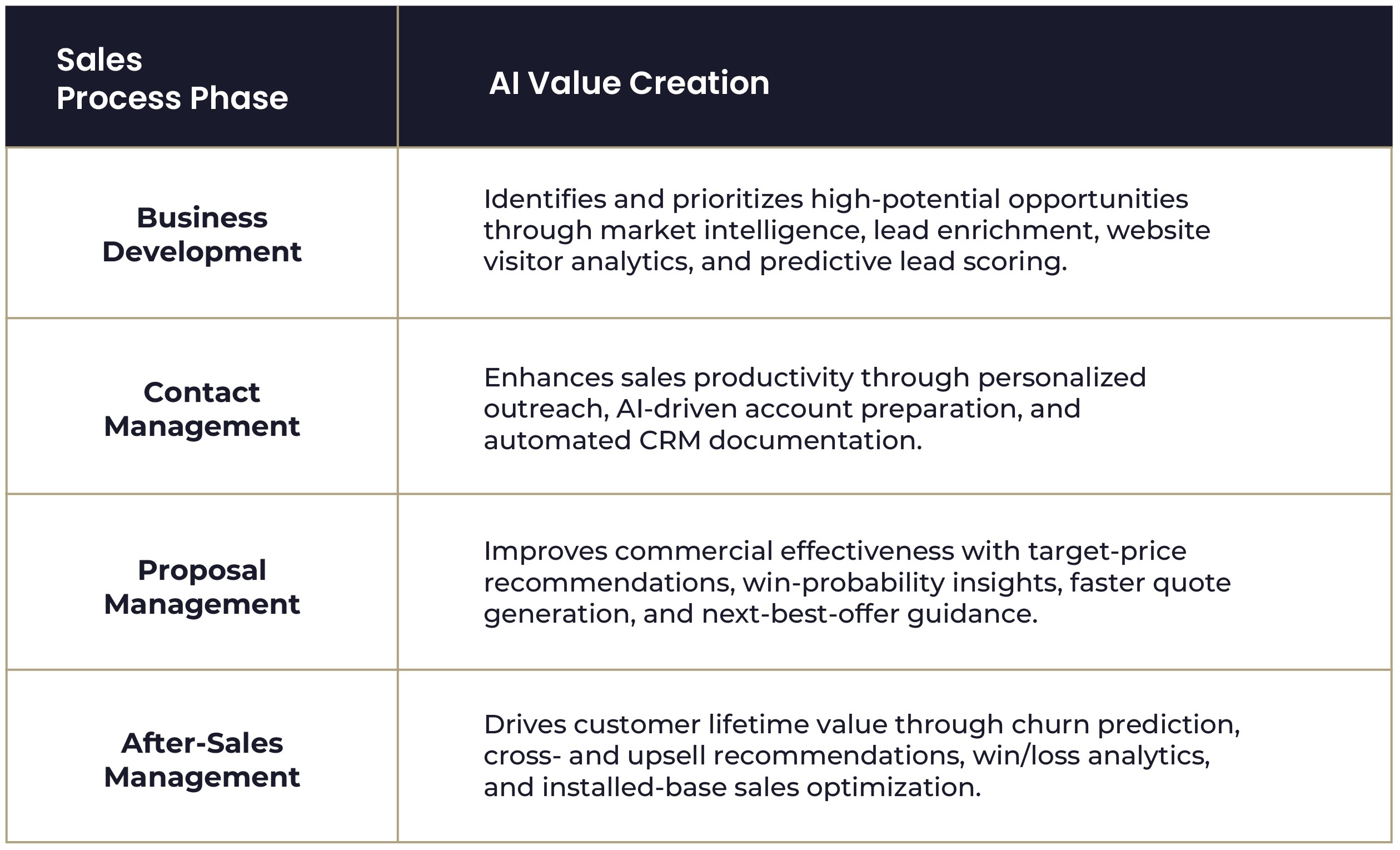
We apply AI selectively along the phases of the sales process – from lead scoring and cross-selling to churn prevention and win/loss analysis.
Starting point: Marketing leads and open opportunities are handled chronologically or based on personal judgment – not according to their actual probability of closing. The result: high lead-processing costs with only moderate conversion. Approach: Our model learns from historical win/loss data which combinations of characteristics lead to high close rates. Each lead receives an automated score, which is combined with expected deal value to create a clear processing priority. Explainable AI methods make it transparent for sales teams which drivers are behind each score. Typical potential: • Conversion rate increased by 15–30% • Sales cycle shortened by 20–30% • Lead-processing effort reduced • Marketing and sales work hand in hand based on a shared, data-driven scoring logic
Starting point: Cross-selling potential remains untapped because sales teams do not systematically recognize which product or service is most relevant for which customer next. Recommendations emerge randomly rather than being data-based. Approach: We develop a recommender engine that uses collaborative filtering and deep-learning methods to predict the most likely next product for each customer based on purchasing, usage, and similarity patterns – including close probability and a clear rationale for the sales team. The recommendation is delivered directly in the CRM system, quoting tool or customer portal. Typical potential: • Cross-selling rate increased by 20–30% • Product holding per customer increased by 10–20% • Customer lifetime value increased by 10–20% • Concrete, data-based conversation starters instead of generic campaign lists
Starting point: Customer churn is only recognized once it has already happened. Costly new-customer acquisition then has to compensate for customers that could have been retained through timely intervention. Approach: We train a model that identifies early warning signals months before actual churn occurs, based on transaction, usage, and interaction data. The results are translated into a prioritization matrix: high-value customers at risk receive personal intervention, while lower-priority cases are addressed through automated measures. Typical potential: • Churn rate reduced by 20–30% • 3–6 months of early warning time for targeted countermeasures • ROI 5–25× higher compared with new-customer acquisition – retention is demonstrably more cost-effective by this factor • Sales gains the time needed to actually save at-risk customers
Starting point: The reasons why deals are won or lost often remain anecdotal. The relevant information is hidden in CRM free-text fields, proposal documents, and emails – not in clean categories. Structured analysis fails because of poor data quality. Approach: Using natural language processing and large-language-model-based methods, we automatically extract win/loss reasons from unstructured sources, cluster them into robust categories and link them with deal characteristics, customer segments, and the competitive situation. Patterns become visible that manual analysis would miss. Typical potential: • 100% coverage of all deals instead of a 5–10% manual sample • Hit rate increased by 5–10% through systematic addressing of loss drivers • Real-time time-to-insight instead of quarterly analysis cycles • Product, sales, and pricing decisions based on genuine market signals

The percentages and timeframes stated above represent typical potential that can be realized in projects of this kind. The actual impact depends on the starting situation, data maturity, and speed of implementation, and is quantified individually as part of the project.

Additional Focus: AI in After-Sales and Service Sales

For mechanical engineering and plant manufacturing companies with a large installed base, we complement sales use cases with specific service and after-sales applications. AI-supported installed-base analyses identify upgrade and retrofit candidates, ROI calculators provide customer-specific business cases, and automated quote generators accelerate spare-parts quoting from days to minutes.


How We Work: The R&P Approach to AI-Driven Sales

In our three-stage process, we design a tailored AI sales roadmap that advances your sales organization quickly and cost-effectively.

Phase 1 – Analysis and Assessment

Which tools are currently used in the sales process, what data is available, and where are the greatest levers? Our experts analyze your sales processes, current data situation, and CRM maturity – uncovering untapped potential along the sales funnel.

Phase 2 – Use-Case Definition and Piloting

From our use-case library, we jointly select the pilot case with the best balance of business impact and data maturity. Within 8–12 weeks, we develop a functioning model, integrate it into your sales processes and define clear measurement points.

Phase 3 – Scaling and Embedding

We expand the use case to additional segments, regions, or product groups, train your sales organization, and establish ongoing monitoring – turning the pilot into a lasting competitive advantage.

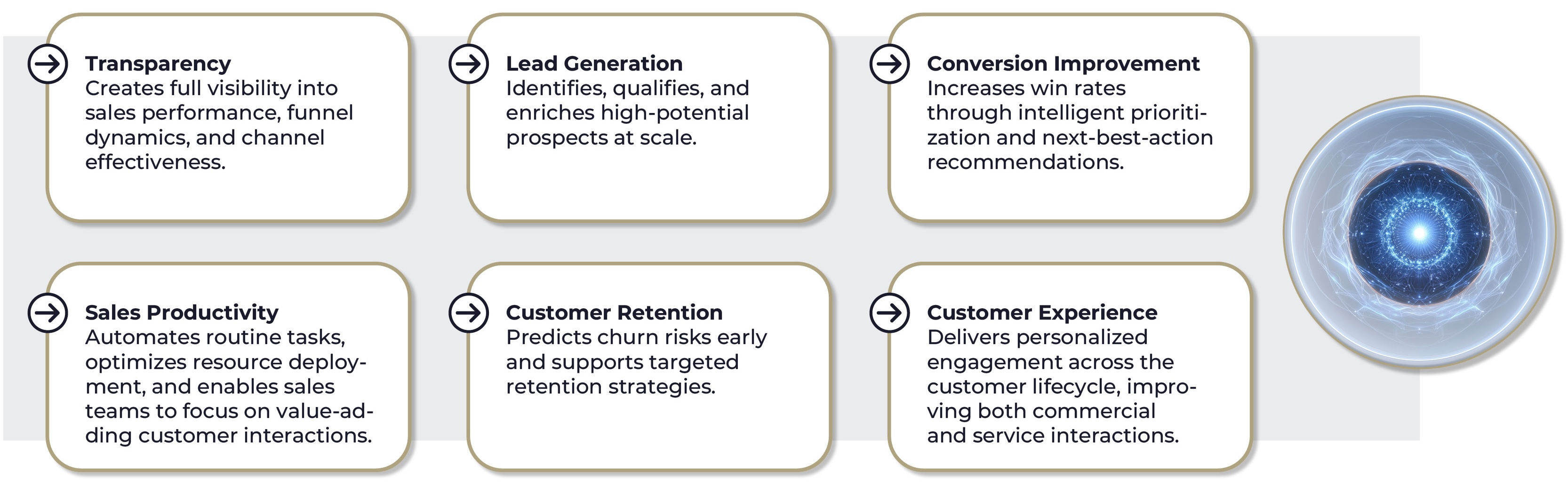
Six Impact Dimensions of an AI-Supported Sales Organization
Success Factors: Why AI in Sales Succeeds – or Fails

AI in sales rarely fails because of model quality. It fails because of a lack of acceptance within the team. Successful projects follow five principles:

  1. Acceptance before algorithm: Sales teams must experience recommendations as support, not as control. Explainability and transparency of the underlying drivers are essential.
  2. Integration into the CRM: Recommendations must appear where sales teams actually work – not in a separate reporting tool.
  3. Data and model quality: Clean master data and regular retraining are the foundation – topics we address consistently together with our Data Science Unit.
  4. Sales enablement: Training, argumentation aids, and incentives that reward AI-supported ways of working.
  5. Iterative development: AI systems only realize their full value over time – monitoring and feedback loops are essential.

The R&P USP: Sales and AI – Under One Roof

While other providers offer either traditional sales consulting or pure AI implementation, Roll & Pastuch combines both worlds:

  • More than 15 years of consulting experience in sales – with deep industry expertise and many reference projects.
  • In-house Data Science Unit with dedicated AI expertise under one roof.
  • Enablement of your sales organization – pragmatic, in weeks rather than years, with the ambition to leave behind functioning processes rather than dependencies.

Let’s Talk About Your AI Sales Boost Initiative

The right starting point for your company can usually be clearly identified in a 60-minute initial consultation. We bring our use-case library and industry experience; you bring your sales and data situation.

Your contacts

Managing Partner

Kai Pastuch is Managing Partner of Prof. Roll & Pastuch. Before joining as Managing Partner, he was Director at a leading international strategy and marketing consultancy. As a graduate in business informatics, he also manages our software company nueprice, which specializes in the pricing of spare parts with the product of the same name. Mr. Pastuch has extensive project management experience from numerous projects for large international companies and German medium-sized businesses in the areas of price management, marketing, sales and strategy. In addition to numerous publications in renowned journals and the publication of the reference books Praxishandbuch Preismanagement and Big Deal Management, he is a sought-after moderator and speaker on all aspects of sales and pricing. As a practice-oriented manager, he likes to get personally involved in our projects and contributes his broad experience in workshops and steerings.

Managing Partner

Gregor Buchwald is Managing Partner of Prof. Roll & Pastuch. He has over 20 years‘ specialist industry knowledge and consulting experience. His focus is on the areas of strategy, pricing and sales. His customers include multi-national companies as well as medium-sized B2B customers. Mr Buchwald has also written numerous publications about strategy, sales and pricing and speaks at numerous events.

Karsten Konrad ist Senior Project Manager von Roll & Pastuch
Dr. Karsten KonradSenior Director Data Science