
AI-Driven Pricing: Protect Margins, Sharpen Pricing Decisions

In many companies, pricing is the discipline with the greatest untapped profit potential. While procurement, production, and logistics have been systematically optimized for years, pricing decisions are still often based on experience, historical table and the outcome of the last negotiation. Artificial intelligence translates the information contained in quotes, orders and condition data into data-based decision support – faster, more consistently and more transparently.

Why AI in Pricing – and Why Now?

The Underestimated Profit Lever

A mid-sized mechanical engineering or plant manufacturing company with thousands of active products, several sales regions and different channels makes hundreds of pricing decisions every day. Each one affects margin. In most cases, this still happens without systematic data support. The data for better decisions already exists – in quotes, orders, discounts, and customer histories. What is missing is a system that translates this data into decision support.

Three Drivers Make the Topic Urgent

  • Market volatility: Raw material prices, energy costs and supply chains fluctuate more strongly than in the past. Prices need to be reviewed more frequently and adjusted more quickly.
  • Professionalization: Many companies have already established pricing guardrails and approval processes. However, these structures are often still managed manually, which limits their impact.
  • Technological maturity: Modern AI models can now be integrated into existing CRM and ERP systems with manageable effort. From a technical perspective, getting started has never been easier.

Important for top management: AI in pricing does not replace strategy. It makes the implementation of existing pricing strategies measurably better – faster, more consistent and more transparent.

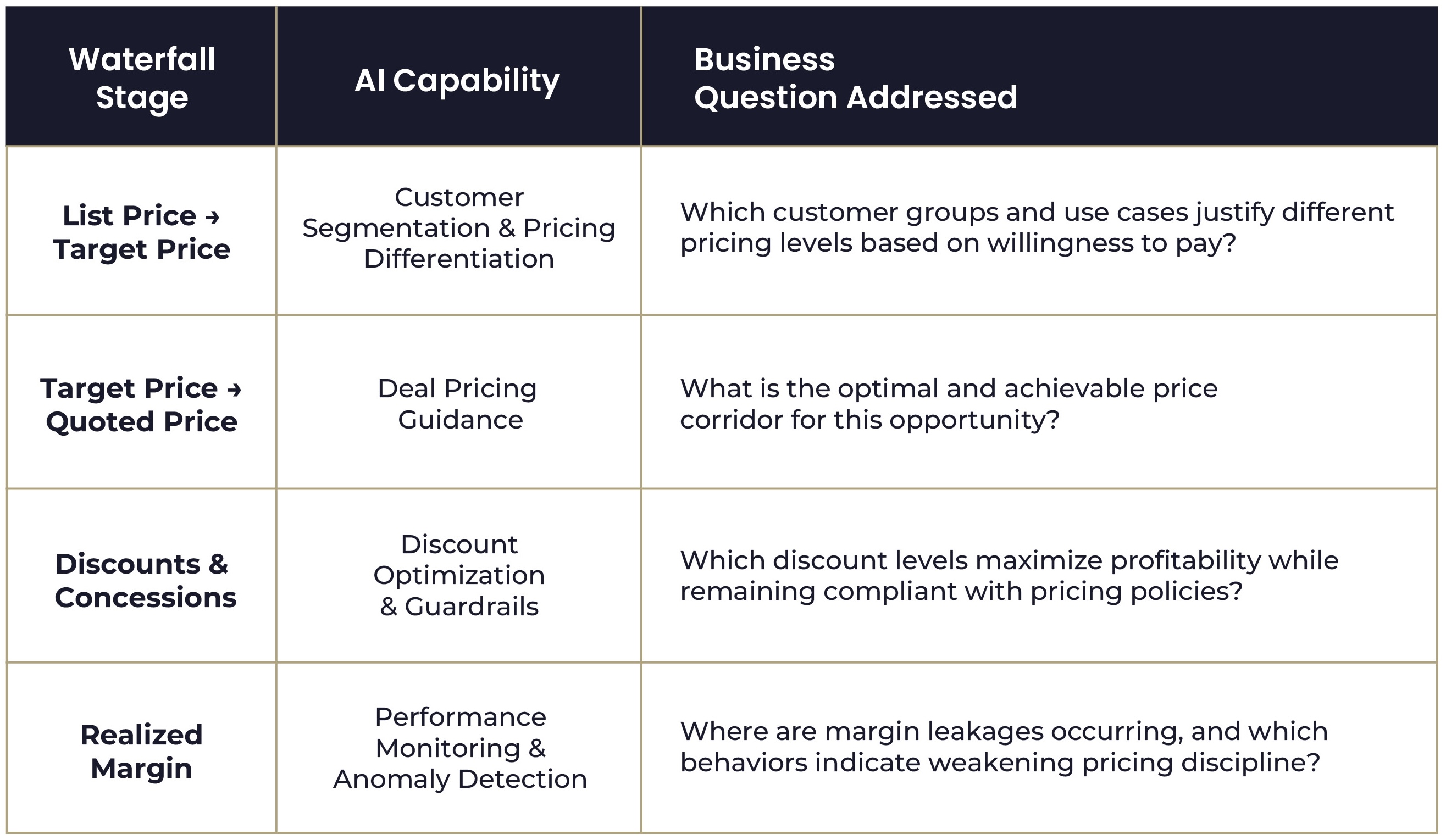
AI Levers Along the Price Waterfall

Instead of speaking abstractly about “AI in pricing”, we identify the point in the price waterfall with the greatest leverage – and start there.

Our Pricing Use Cases

The following use cases are selected so that they can be piloted in many industrial companies – without first having to build a perfect data platform.


Starting point: Pricing has developed historically, and there is no pricing engine in place. Prices are derived from old quotes and gut feeling – with high variance and no transparency on the actual price level of comparable deals. Approach: We develop a peer-pricing algorithm that automatically identifies the most similar historical cases for each new request using similarity-matching methods. Based on these peers, it derives an empirical price range and a data-based target price. An integrated price traffic light shows the sales team in real time where the current offer price sits in its historical context – including specific reference cases as justification anchors. Typical potential: • +1.5–3% margin through more consistent price setting • Significantly reduced price variance • Quote preparation accelerated from 2 hours to under 15 minutes • High acceptance in sales – every recommendation is based on real comparable cases, not a black box
Starting point: Sales teams decide between margin and win probability for every offer – without a data-based foundation. Discounts are granted “just to be safe”, high-margin deals are unnecessarily lost, and price-sensitive customers are deterred by offers that are too high. Approach: Based on historical win/loss data, we train a machine-learning model, such as gradient boosting, that predicts the win probability and expected contribution margin for each price point. Sales receives a decision surface with clear labels such as “win-oriented”, “balanced”, and “margin-oriented” – embedded in guardrails and automatic escalation logic. Typical potential: • +2–4 % margin • Win rate in competitive deals increased by 5–10% • Exception approvals reduced by 30–40% • More deliberate, faster pricing decisions based on solid data
Starting point: In transparent online markets or for standard products, competitor prices change daily – sometimes several times a day. Manual market monitoring captures these movements only sporadically and with a delay. The result: missed margin opportunities when competitors increase prices, and sales declines when competitors undercut aggressively. Approach: We deploy web scrapers that continuously monitor the price gap to relevant competitors across all relevant channels, platforms, and marketplaces. Using defined anchor products, we align the assortment with the competitive environment in a targeted way: market changes are automatically detected, and price adjustments follow a rule-based anchor logic with clear guardrails for minimum margins and maximum price-change steps. This allows you to respond dynamically to market movements without manually intervening in every category detail – while retaining control, as category management governs the anchor logic and approves special cases. Typical potential: • Daily updated view of the competitive landscape instead of sporadic manual checks • Response time to competitor movements reduced from days to minutes • +1–3% margin through more consistent competitive positioning across the entire assortment • Manual maintenance effort reduced by more than 70% – with control remaining in category management
Starting point: Companies with tens of thousands of items maintain thousands of pricing rules – and still end up making numerous manual individual decisions. Prices across product variants are inconsistent, the long tail drifts and there is no systematic pricing logic for new products. Approach: Our algorithms automatically identify the relevant value drivers within a product family and derive mathematically sound pricing formulas from them. These formulas form the new, consistent price architecture: margins can be optimized in a targeted way, historical pricing outliers are systematically identified, and new products automatically receive a price-logically correct launch price. Typical potential: • +2–5% margin in the long-tail portfolio • 10–20% of products identified as mispricing candidates • Manual maintenance effort reduced by 70–80% • Time-to-price for new products reduced from days to minutes

The percentages and timeframes stated above represent typical potential that can be realized in projects of this kind. The actual impact depends on the starting situation, data maturity, and speed of implementation, and is quantified individually as part of the project.

How We Work: The R&P Approach to AI-Driven Pricing

Pragmatic Entry Instead of a Big-Bang Project

In our experience, peer pricing or anomaly detection in the price waterfall are often particularly suitable entry points. Both use existing quote and order data and deliver initial results within just a few weeks. Building on this, we jointly develop a maturity path that guides your pricing organization step by step toward data-based steering.

Three Phases of Our Approach

Phase 1 – Diagnosis:

We analyze your pricing data, identify the greatest levers in the price waterfall and define the optimal pilot use case together with you.

Phase 2 – Piloting:

Within 8–12 weeks, we develop a functioning model and integrate it into your sales or pricing processes – with clear guardrails and measurement points.

Phase 3 – Scaling: 

We extend the use case to additional product groups, regions, or channels and enable your organization to develop the solution independently.

Success Factors: Without Anchoring, AI Becomes Background Noise

In practice, AI in pricing rarely fails because of the mathematical quality of the models. It fails because it is not sufficiently embedded in the organization and its processes. Successful projects follow five principles:

  1. Clear ownership: Pricing owns the logic, IT/Data owns the technical implementation – without interface conflicts.
  2. Commitment: AI recommendations are integrated into quote and approval processes – as a mandatory field, not as an optional hint.
  3. Human in the loop: For major deals and key accounts, the human decision-maker remains in control – with a better information base.
  4. Sales enablement: Argumentation aids, training, and incentives that reward good pricing.
  5. Monitoring: Adoption, performance, and drift are continuously measured – with a clear process for further development.

The R&P USP: Pricing and AI – Under One Roof

While other providers offer either traditional pricing consulting or pure AI implementation, Roll & Pastuch combines both worlds:

  • Many years of top-management consulting experience – with references in mechanical engineering, chemicals, electronics, consumer goods and software.
  • In-house Data Science Unit with dedicated AI expertise – not a subcontractor, but well-established teams working hand in hand.
  • Pragmatic consulting approach – impact in weeks rather than years, with clearly defined pilot projects.
  • Proprietary software modules such as nueprice and the R&P Pricing Toolbox, making our methodology directly usable.
  • Enablement of your organization – we build capabilities and leave behind functioning processes, not dependencies.


Let’s Talk About Getting Started with AI Pricing

The right starting point for your company can usually be clearly identified in a 60-minute initial consultation. We bring our use-case library and industry experience; you bring your data and process situation. By the end of the conversation, you will have a clear view of a possible first step.

Schedule an initial consultation


Your contacts

Managing Partner

Kai Pastuch is Managing Partner of Prof. Roll & Pastuch. Before joining as Managing Partner, he was Director at a leading international strategy and marketing consultancy. As a graduate in business informatics, he also manages our software company nueprice, which specializes in the pricing of spare parts with the product of the same name. Mr. Pastuch has extensive project management experience from numerous projects for large international companies and German medium-sized businesses in the areas of price management, marketing, sales and strategy. In addition to numerous publications in renowned journals and the publication of the reference books Praxishandbuch Preismanagement and Big Deal Management, he is a sought-after moderator and speaker on all aspects of sales and pricing. As a practice-oriented manager, he likes to get personally involved in our projects and contributes his broad experience in workshops and steerings.

Managing Partner

Prof. Dr. Oliver Roll is Managing Partner at Prof. Roll & Pastuch. He is one of the leading pricing experts in the DACH region and has led pricing, sales and strategy projects for numerous international companies. Furthermore Prof. Roll is a key note speaker on the topic of price management and has published numerous articles on various aspects of the pricing process. Prof. Roll holds the chair of „Price Management“ at the Osnabrück University of Applied Sciences.

Karsten Konrad ist Senior Project Manager von Roll & Pastuch
Dr. Karsten KonradSenior Director Data Science