
Commoditized products under particular pressure due to current dynamics in e-commerce
Particularly in the sale of traded goods—whether via platforms like Amazon or in their own webshops—many mid-sized retailers are under significant pressure: product offerings are increasingly interchangeable, customers compare prices within seconds, and make decisions based on just a few cents—whether to click, convert, or abandon. While platforms like Amazon, Idealo, or Google Shopping enable real-time comparisons, many mid-sized retailers face a dilemma: how can they remain competitive without continuously eroding their margins?
What is the status quo among e-commerce retailers?
The status quo reveals a clear pattern: price adjustments are often made manually, reactively, and without a system. Strategic approaches are lacking, and competitor prices or contribution margins are not sufficiently incorporated into pricing decisions. Instead of targeted management, uncertainty dominates—such as how much prices can be increased without losing sales. Added to this are a wide product assortment, a lack of assortment logic, and the challenge of profitably reducing inventory with low sell-through rates without falling into a discounting spiral.

Why pricing in e-commerce is so challenging
Price in e-commerce is a constant balancing act—between competitiveness, profitability, and customer acceptance. Unlike in brick-and-mortar retail, where purchasing decisions are often more emotional and less comparison-driven, online purchases are shaped by complete transparency in just a few seconds. This leads to specific challenges that burden many mid-sized retailers:
The biggest challenges in e-commerce pricing
- Extreme competitive pressure & price transparency: Marketplaces and comparison platforms put retailers under constant pricing pressure
- Margin loss despite revenue growth: Without strategic pricing, profits fall short of their potential
- Manual processes & lack of systematics: Pricing is often unsystematic, error-prone, and not scalable
- Data gaps in pricing decisions: Key factors such as competitor prices, inventory coverage, or target margins remain unused
- Uncertainty about price effects: Lack of understanding of price elasticity leads to poor decisions and missed opportunities
To systematically tackle these challenges, more than mere price reactions are needed — it requires a strategic understanding of key pricing concepts that make a difference, especially in e-commerce:
- Dynamic pricing adjusts prices automatically based on real-time data such as demand, competition, and inventory. It enables e-commerce retailers to stay competitive and strategically manage margins
- Price elasticity measures how demand changes in response to price adjustments. It is a key control factor in e-commerce for optimizing margins—taking into account seasonality, cannibalization, and competitor behavior
- Value drivers such as product lifecycle, inventory status, or private-label status provide the basis for differentiated pricing logic. They help integrate internal product characteristics into the pricing strategy
- Psychological price thresholds use familiar price points (e.g., €9.99) to positively influence purchasing decisions. In e-commerce, they increase conversion without actually lowering prices
- Assortment roles classify products, e.g., as price drivers or profit contributors. They create transparency regarding the function of individual items and enable role-specific price management
What retailers aim to achieve
E-commerce retailers primarily pursue three central goals: they want to strategically increase their margins without losing customers, remain competitive without constantly undercutting themselves, and actively manage their assortments rather than reactively offering discounts. Achieving this requires a strategic, data-driven pricing logic—not manual individual decisions, but clear rules that align economic objectives with market dynamics.
Pricing as a management tool
Strategically implemented pricing is far more than a reaction to market changes—it is a central management tool for profitability, competitiveness, and assortment dynamics. Retailers who use pricing strategically gain transparency over assortment logic, competition, and price effects, can optimize margins, manage sales, and intervene in conversion in a targeted way. Instead of relying on blanket discounts or spontaneous price adjustments, rule-based, data-driven pricing enables the controlled achievement of economic goals—automated, traceable, and scalable.
From analysis to automation – your all-in-one pricing solution
Effective e-commerce pricing requires more than isolated analyses or manual tools—it needs an integrated solution that seamlessly combines strategy, data, and technology. That’s exactly what we offer: a product-focused, full-featured single-source solution, covering everything from implementing market-based price monitoring to the technological tooling for automated price management. We combine strategic clarity with operational excellence—creating the foundation for pricing that works: precise, scalable, and aligned with your goals.
The Price Engine
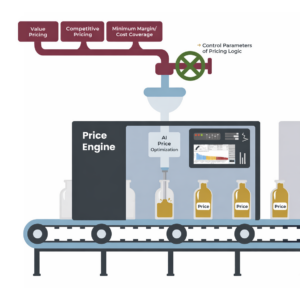
How the Price Engine works
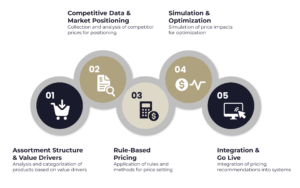
Ausführung der einzelnen Schritte
1. Assortment structure & value drivers
First, the assortment is systematically analyzed and classified into assortment roles—e.g., focus products, service assortment, peripheral items, or premium segments. In addition, value drivers such as inventory status, private-label status, or product lifecycle are taken into account. This differentiation forms the foundation for tailored pricing strategies.
2. Competitive data & market positioning
Using automated price crawling and competitor monitoring, relevant competitor prices are collected, cleaned, and segmented. The engine applies market-based pricing logic—such as distances to the median, top-3 comparisons, or fallback rules when no comparable prices are available. Price thresholds and psychological pricing structures are also taken into account.
3. Rule-based price calculation
For each product group, a dedicated set of pricing rules is defined: minimum margins, price gaps, tiered pricing, price rounding, and price thresholds. Depending on the assortment role, the appropriate pricing methodology is applied—e.g., competitor-based pricing, value pricing, or differentiated markup.
4. Simulation & optimization
The Price Engine simulates the effects of pricing on margins, sales, and competition—taking into account price elasticity, volume effects, and pricing psychology. This allows economic outcomes to be validated in advance and pricing decisions to be secured.
5. Go-live & integration
Price recommendations are automatically transferred to shop or ERP systems—via API, file, or manually. Through dashboards with daily updates, retailers can maintain full control over price effects, Buy Box performance, and assortment rotation at all times.
The benefits of the Price Engine at a glance
 3–8% higher margins through differentiated pricing logic
 Faster price updates thanks to an end-to-end process chain
 Targeted sell-through through price-driven assortment rotation
 Less manual maintenance and fewer errors in pricing decisions
 Clearly documented logic – no guesswork in pricing decisions
 Scalable & integrable – from Excel prototype to API-based implementation
Learn more about your e-commerce pricing potential
We are happy to assist you with any questions and provide further information.

Christoph Krauss
Christoph Krauss ist Associate Partner bei Prof. Roll & Pastuch. Er verfügt über mehr als 20 Jahre Erfahrung in Marketing und Vertrieb bei führenden Konsumgüterherstellern sowie in der Beratung von Kunden in den Bereichen Vertrieb, Strategie und Pricing. Herr Krauss hat sich insbesondere auf Kunden im B2C-Bereich fokussiert.