
PricingSales
Cheap online, expensive in-store – this very discrepancy puts many multichannel retailers under pressure to explain themselves. When...

Warren Buffett once said: “Pricing power is the single most important decision in evaluating a business.” Enough reason to take a closer look at the concept of pricing power. In this article, we invite you to a thought experiment – after reading, your understanding of pricing power will never be the same.
Pricing power is often understood as a company’s ability to change prices without significantly affecting demand or the quantity sold. But does this definition really capture the essence? Isn’t it a bit too narrow?
The classic definition relates directly to price elasticity – the change in quantity demanded in response to a price change. Companies with high pricing power therefore have a price elasticity close to zero: a price increase does not reduce sales volume. But is this theoretical construct the whole truth?
We see three central errors in interpreting pricing power, which we will explore below:
1) Price elasticity is relative:
Price elasticity measures the percentage change in demand in response to a price change. Empirical evidence shows that it varies across market segments – some segments are more elastic, i.e., more price-sensitive, than others. Pricing power cannot be considered independently of industry, market, or segment. It is rather a relative comparison in competition: How elastic are my company’s products compared to competitors and their market behavior? How independent is my pricing in the market environment? Do I have to align with competitors or market trends such as cost pressures?
2) Pricing power has natural limits:
Suppose a company with high pricing power raises prices without losing volume. How often can this process be repeated? Eventually, even the strongest company will experience sales losses. Every price elasticity has its limits: at a certain point, the losses in volume outweigh the gains from higher prices. What then? Does pricing power become irrelevant?
3) Historical pricing errors:
If a price increase causes little loss in volume, the price was clearly too low before. Customers were willing to pay more. Perhaps the low price was intentionally set to suppress competition. But just because a price can be raised without significant volume loss does not automatically mean high pricing power. In both cases, margin was previously sacrificed. In the short term, pricing power can thus be the correction of inconsistencies or an aggressive pricing strategy – but can this really be called “power”? Once these distortions are corrected, the question arises: Is pricing power still relevant?
To answer this, we need to expand the understanding of pricing power. Real pricing power does not only contribute to short-term profit but also ensures sustainable business development. It is more than just setting a price point or correcting historical errors. Pricing power is closely tied to the value a product or service provides to customers – through the product itself, the brand, or the customer relationship.
Additionally, pricing power can be increased within commercial excellence initiatives. It is especially a result of holistic end-to-end price management.
In the long term, pricing power is a company’s ability to manage prices resiliently. This includes a robust and clear pricing strategy, optimal capture of customer willingness to pay, and consistent enforcement of prices in the market.
A concrete example: Companies with true pricing power are those that remained in the “driver’s seat” of pricing even during past crises – with clear price adjustment processes and decision frameworks – whereas companies with low pricing power are driven by market developments.
You might argue that in your industry, market dependency is so high that pricing power is unattainable. However, we see resilient companies with high pricing power across many industries. So how can you increase your pricing power and build sustainable, resilient price management?
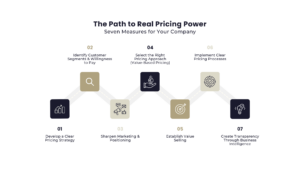
Develop a clear pricing strategy: Establish a distinct positioning and deliberate guidelines for pricing. Consider price-to-value, i.e., translating product value into a price. Avoid opportunistic actions based on market circumstances or individual sales opinions.
Segment customers and understand willingness to pay: Through thorough pricing analysis, differentiate between customer groups and enable effective price differentiation. Capture price elasticity and optimal price levels for each segment.
Sharpen marketing and perception: How is your product perceived in the market? As a “cleaner” or as a “premium surface treatment”? Targeted marketing increases perceived value and differentiates the product from pure price competition.
Choose the right pricing method (Value Pricing): Find the optimal combination of effort and benefit for your portfolio, organization, and customers. Capture customers’ willingness to pay as precisely as possible. Consider the full offering: only the product, or a holistic solution including services? Highlight both the product and related services.
Establish Value Selling: Equip your sales team to sell the value of your solution instead of just the price. Use tools like battle cards or benefit calculators. A production visit can make sales teams aware of the complexity of custom solutions (and the associated price) – often an eye-opener.
Implement clear price processes: Define explicit processes and responsibilities for pricing. For price adjustments, have triggers, differentiated calculations, simulations, and established communication channels to sales and customers. Clear processes prevent operational errors that could lead to inconsistencies or damaging ad-hoc discounts.
Create transparency through business intelligence: Effective BI monitoring allows you to understand the status quo, make informed decisions, and respond early to market changes.
Pricing is tempting to view as a short-term lever. But the most successful companies approach pricing holistically and align their entire business model to value creation. Pricing champions are independent and resilient in their pricing, while others remain dependent and must continually react and adjust.
Don’t just look at the usual suspects like Apple, Rolex, and LVMH. Role models are often closer – hidden champions and internationally active mid-sized companies, such as Hansgrohe (sanitary), AIXTRON (semiconductors), or B. Braun (medical technology). There is much to learn from them.
Invest in a comprehensive pricing strategy and build true pricing power – for sustainable success in your market.