
Pricing
The Business Model Canvas has become the standard for business model development. However, to be successful and, above...

Cheap online, expensive in-store – this very discrepancy puts many multichannel retailers under pressure to explain themselves. When online shop prices are adjusted dynamically (for example through dynamic e-commerce pricing), visible differences to in-store prices quickly emerge. Customers often perceive this as unfair, especially when they are asked to pay significantly more in a physical store than online. This makes a clear pricing strategy all the more crucial—one that defines and transparently communicates the relationship between online and offline prices. Retailers who master this balancing act not only protect their margins but also strengthen customer trust in their brand.
In-store shelf prices:
In physical stores, price changes occur far more slowly than online. Without electronic shelf labels (ESL), employees must manually replace price tags, which limits responsiveness. Even though offline consumer behavior differs from online behavior (e.g., fewer real-time price comparisons), in-store sales remain sensitive to online price differences. Customers are still able to compare prices across channels, meaning that even brick-and-mortar competitiveness is influenced by online pricing.
E-commerce prices:
Online pricing is far more dynamic and transparent. Webshop prices can theoretically be adjusted multiple times per day to keep up with competitors (such as Amazon). Consumers have numerous comparison options online, so even small price deviations are immediately noticeable. As a result, competitiveness in the online channel often has to be secured through aggressive pricing. However, extreme online price adjustments can quickly lead to conflicts with in-store prices if no coordinated strategy exists.
A fundamental strategic decision is whether—and how—pricing across channels should be linked. Retailers can choose from different models to align or deliberately differentiate online and offline prices. The three most commonly used are:
There are several additional variations. In practice, many retailers combine elements of multiple models, depending on their assortment, competitive environment, and technical capabilities.
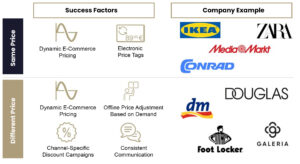
There is no single “correct” multichannel pricing strategy. Different retailers demonstrate how diverse successful online-vs.-offline pricing strategies can be. Broadly speaking, two approaches can be observed:
Same price across all channels:
Some retailers pursue a strict one-price policy, offering products at the same price online and offline to provide a consistent customer experience. Examples include IKEA, toom, Conrad, MediaMarkt, and Zara, all of which operate with such an omnichannel strategy. This approach strengthens customer trust in price fairness and prevents cannibalization between channels. However, it requires significant coordination: online prices must often be adjusted without constantly changing in-store signage. Modern technologies such as ESL can help maintain channel consistency despite high price-change frequency, further intensified by dynamic pricing.
Different prices by channel:
Other retailers deliberately allow price differences between online shops and physical stores. Examples include dm, Galeria, Decathlon, Douglas, and Foot Locker. These companies leverage the flexibility of e-commerce to use dynamic pricing and individualized promotions online. Prices may be adjusted based on demand, competitive offers, trends, or even time of day, while in-store prices often remain more stable. Channel-specific discounts can also lead to price differences. With this strategy, however, it is essential to keep differences controlled, communicate them clearly, or guarantee in-store price matching upon request. Customers typically accept only limited deviations between online and offline prices without changing their purchasing behavior.
Regardless of the chosen pricing strategy, without consistent customer focus and transparent communication, even the best implementation will fall short. Retailers using channel-dependent pricing must clearly and visibly communicate this—especially the fact that lower online prices do not automatically apply in-store. Otherwise, customers quickly feel misled and lose trust. Successful multichannel retailers therefore closely align pricing, marketing, and sales to deliver a consistent pricing message across all channels. In the end, a fair and comprehensible pricing approach is the most important foundation for sustainable customer loyalty.
Would you like to know which multichannel pricing strategy best fits your business model? We would be happy to support you—get in touch with us.