
Enforcing Price Increases – Good Reasons to Review Adjustments
From a consumer perspective, prices continue to rise year after year. Products are becoming significantly more expensive. In fact, price adjustments by many suppliers – including in areas such as commodities, raw materials, energy, and even electronic components – are putting substantial cost pressure on many manufacturers. Announcements from competitors to offer their products at higher prices can be seen as a welcome invitation to raise your own prices as well. What has changed over time? Several key aspects have emerged:
- For a long time, many industries had a kind of price guarantee and at most a moderate annual price increase. Today, price adjustments are handled much more flexibly, and the question is different: How often should you recalculate prices and implement a price increase?
- To compensate for margin losses, new rules now apply. It is also important to find the right timing and pass on cost increases promptly as price adjustments to secure your own economic viability.
- Instead of accepting a large gap between a planned and an actual price increase, successful entrepreneurs set the course so that the previously announced price increase is implemented successfully.
- Raising prices is a central leadership task. Instead of accepting financial losses, companies prepare a solid communication and announcement strategy for the price adjustment.

Herausforderungen einer erfolgreichen Preiserhöhung
Many business leaders are aware that their company is not optimally prepared to plan price increases effectively, calculate them with precision, and implement them successfully in the market. This competence gap presents existential challenges for many entrepreneurs.
Often, companies lack a solid price adjustment process with clear responsibilities. In critical situations, especially when price adjustments are required at short notice, this leads to a rushed approach that surprises and overwhelms the organization. Important information and key foundations, such as market and cost analyses, are missing to ensure the success of the price increase. Historically, companies have often made price adjustment calculations too simplistically.
For example, they have raised prices across the entire portfolio in a blanket manner. This approach reaches its limits in the face of drastic cost fluctuations. Furthermore, it has often been overlooked how customers perceive prices and how they inform themselves about them. This can lead to an unintended exceedance of their willingness to pay, causing customers to cancel services and subscriptions and being unwilling to pay the increased prices for products.
Finally, there is often a lack of systematic preparation of the sales team for the actual negotiations. The team rarely receives central argumentation guidelines or prepared data to customize and prepare negotiation discussions for specific customers.
Raising Prices: Overcome the Key Obstacles with Our Help
- Rushed approach due to a lack of a systematic process for price increases
- Targets set only at gross (list price) level – no definition of net targets (at a detailed level)
- No systematic differentiation of price increases by product segments
- Suboptimal sales preparation: missing value argumentation, no detailed negotiation planning, no customer-specific targets
- Insufficient backing from management
- Revenue-based incentive systems
- Lack of transparency / tracking at the net level
Case Study: Price Adjustment
The importance of regularly adjusting prices is illustrated by a simplified example: If a company with a ten percent profit margin manages to implement a two percent price increase without losing volume in the market, its EBIT increases by 20 percent. As shown graphically, a price increase has a direct impact on earnings. This leverage is even greater the lower a company’s profit margin is. Often, it is not only about increasing profitability, but primarily about passing on substantial cost increases.
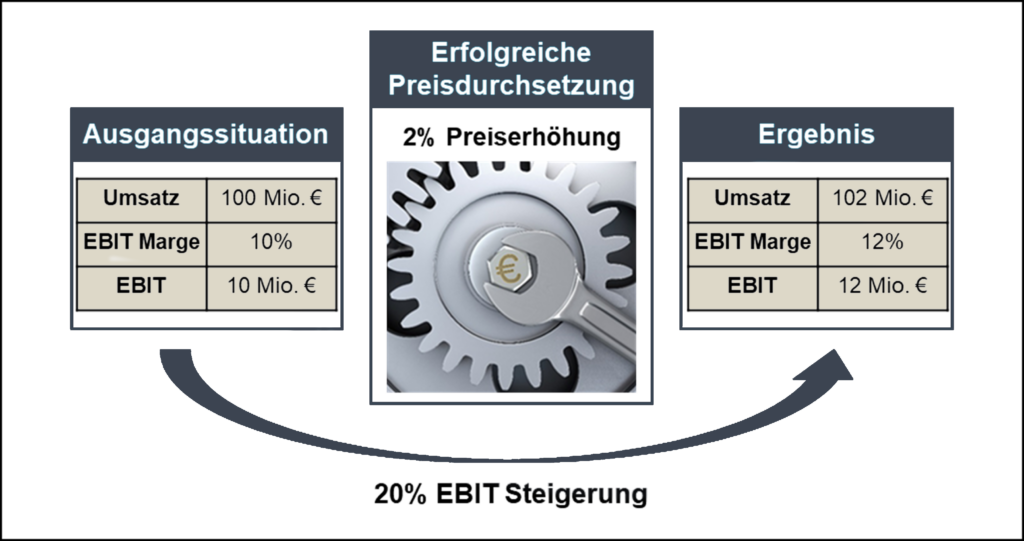
When companies initiate activities in other areas with comparable impact, large projects with multiple quality gates are launched with significant (formal) effort, and detailed (data/market) analyses are conducted. Unfortunately, price increases are rarely approached with the same level of rigor.
Successfully implementing a price increase in competitive industries is not trivial. Prices are a highly sensitive topic, and customers are always looking for loopholes to avoid paying the adjustment. There is no standard template for the next price increase. However, the following tips will help you act more confidently and successfully.
Plan Price Adjustments in Advance
Price increases are often initiated very hastily due to acute cost pressures. This usually leads to decisions based on suboptimal information and gives the sales organization no chance to prepare the reasons for price changes. In most cases, this rushed approach ultimately results in enforcement far below the level expected by management.
Predefined triggers for price adjustments – for example, competitive actions or cost increases – should be clearly defined in advance to systematically involve stakeholders such as procurement in the process. Avoid repetitive adjustments caused by different departments reporting cost increases that force additional price hikes.
Establish a systematic process in advance with clear responsibilities regarding the definition of targets, competitive and market analyses. Preparing the sales team and aligning customer-specific goals must be planned and organized beforehand. If contracts contain a clause allowing you to raise prices in principle but only with long lead times, make sure to notify these contracts in time.
Das Ziel für die Preiserhöhung gekonnt setzen
Fixing the price adjustment target is a major challenge – there is usually uncertainty about the level of the new prices. The enormous profit potential is countered by the concern of losing sales and, ultimately, revenue. This is especially true in companies with revenue-based incentive systems.
This fear is fueled, not least, by a phenomenon called “availability bias”. People tend to assess risks as much more likely when they hear, read, or talk about them frequently. When price adjustments occur, the existing customer base and their feedback serve as the strongest reference point for the sales team. Salespeople rarely have insight into colleagues’ or even competitors’ offers. Due to this information deficit, the risks of a price increase are often overestimated, resulting in a too conservative approach to the adjustment and ultimately missed profit targets.
Gather all relevant information in advance of the price adjustment. Involve all relevant market experts within the company
and use analyses of the market and competitive environment to overcome uncertainty.
It has been shown how important it is to fully involve procurement in order to obtain the most reliable forecast for costs. This also means being able to anticipate price reductions in the market and respond accordingly.
Compare the development of your net prices with relevant price and cost indices. At this point, it is important to focus particularly on net realization, not just the pure list price adjustments of recent years. Many companies have increased their gross list prices but have barely been able to adjust the net level.
If you plan a price adjustment beyond the market standard or a repositioning of important product segments, it is advisable to estimate sales effects with the help of sales experts. This provides significantly higher transparency regarding potential revenue and profit effects and thus a solid basis for further action.
Preiserhöhung richtig kalkulieren
It may seem simple to increase the entire portfolio across the board as part of a price adjustment. However, this pragmatic approach carries the significant risk of artificially distorting the entire price structure.
In doing so, you may price products that are under little or no cost pressure out of the market through the uniform increase, thus endangering the corresponding sales. On the other hand, significant cost increases in particularly affected product areas are not compensated. As a result, margins are insufficient, and customers benefit from offers far below the market standard.
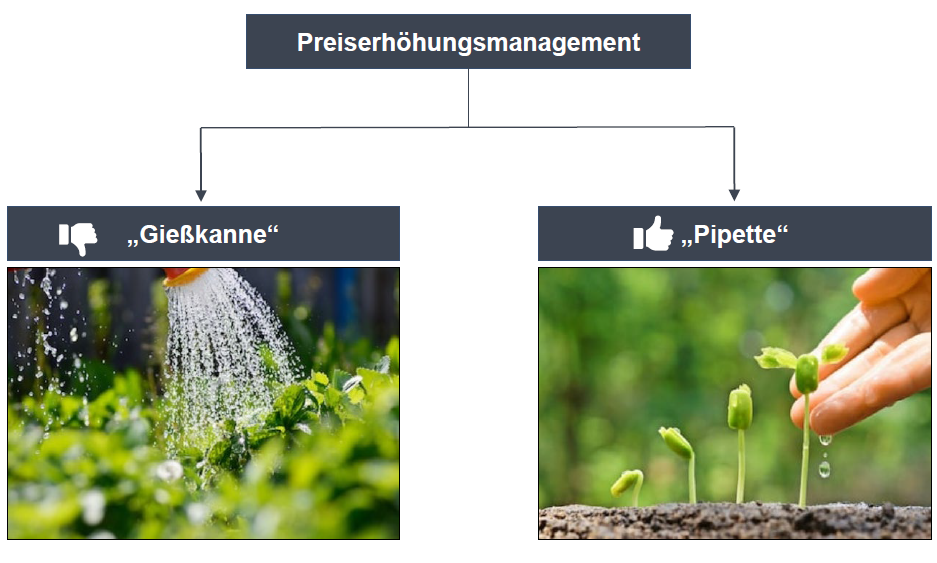
As a business owner, depending on the complexity of your product portfolio and business, you should create segments to target products in the market when implementing a price adjustment. Be especially careful with products that are easily sourced, have high sales, or are widely distributed. Greater pricing flexibility is often available for niche assortments and special products.
Where possible, differentiate price adjustments across industries and regions. Good preparation is essential for this, particularly the analysis of industry and regional trends, to make optimal decisions.
Involve Sales in the Price Increase
Often, customers have very different price positions and conditions based on historical factors. Therefore, full implementation is not always possible. Use the expertise of the sales team to plan customer-specific price increases. Employ tools to differentiate potential price adjustments across regions and actively incorporate input from the sales team, as they know the customers best. This not only improves the quality of planning but also increases the sales team’s commitment.
To ensure the price adjustment is not interpreted individually by sales, it is essential to establish clear rules and guidelines. This way, the sales team does not need to initiate time-consuming inquiries and is fully informed about their decision-making authority.
Enforce Price Increases Using Data
Use data to provide the sales team with account profiles. Actively share valuable information to support negotiations. It is essential, prior to a negotiation, to know whether the customer has grown or shrunk in recent years. It should also be checked whether historical discount allocations could be converted into incremental revenue.
With such a solid information base, the field sales team can analyze its key customers and set concrete goals for the price negotiation, including the opening offer, negotiation target, and minimum acceptable outcome.
Provide Reasons: How to Argue a Price Increase Correctly
There are many reasons for a price increase. But how do you explain a price increase to a customer? Below, we provide practical tips.
- Prioritize Transparency: Start with the specific reasons for the price increase, ideally those that are externally relatable. Open communication builds trust and reduces potential resistance. Price increases are never an easy decision and can cause uncertainty for customers.

Argumentation Tips: Communicating Price Increases
- Demonstrate Commitment: Before informing customers about price increases, it is essential to create a basic understanding of your situation. Explain transparently which external circumstances or internal decisions led to this measure. Are rising raw material costs, wages, or investments in product quality the reasons? Be honest and direct, as customers value transparency.
- Emphasize your intensive efforts to reduce costs, so that externally imposed cost increases are only partially passed on to customers.

How to Communicate a Price Increase to Your Customers
- Create Understanding for the Price Increase, but Show Empathy: Understand and address your customers’ concerns. An empathetic approach can help mitigate negative reactions.
- Offer Alternative Solutions: Where possible, provide alternatives or adjustments for customers who may be particularly affected by the price increase. Discounts or loyalty programs can be an effective way to strengthen customer loyalty. Ensure that the alternatives are also viable for your business.
- Emphasize Added Value: Explain how the price adjustment contributes to improving the product or your services. Customers are more willing to pay more when they understand that they are receiving greater value in return.

Inform Internally About Price Changes
Communicate the necessity of the price adjustment internally in a clear and unambiguous manner, and make it clear that management fully supports the sales team. Often, it is unclear in which cases certain customers or revenue can be forgone. Therefore, make it clear to the sales team whether the focus is on growth or profitability, and in which segments (unprofitable) revenue can potentially be sacrificed. The goal is not to predict market share and EBIT to the decimal, but to send a clear and reliable signal to the team. Stand behind the sales team in the event of customer escalations and reinforce their position. Nothing is more dangerous in the long term than letting customers know that they only need to escalate higher in the hierarchy to receive a better price.
Prepare Negotiations and Arguments Internally
Price negotiations are uncomfortable for many sales representatives. Precisely for this reason, they require thorough preparation – if the sales team falters during customer interactions, the implementation of a price adjustment is quickly at risk.
Therefore, clarify typical customer questions in advance and provide the sales team with usable argumentation chains and tools. With centrally prepared materials and instruments for value-based argumentation, you shift the focus away from a purely cost-based narrative. It has often proven very valuable to demonstrate to the customer transparently which efforts were made to limit the price increase. In addition, communicate to the customer, where applicable, how your solution helps them reduce their own total costs in the medium term, for example through energy savings for a faster ROI.
Your contact person